

What Are AI Citations and Why Do They Matter for Publishers?
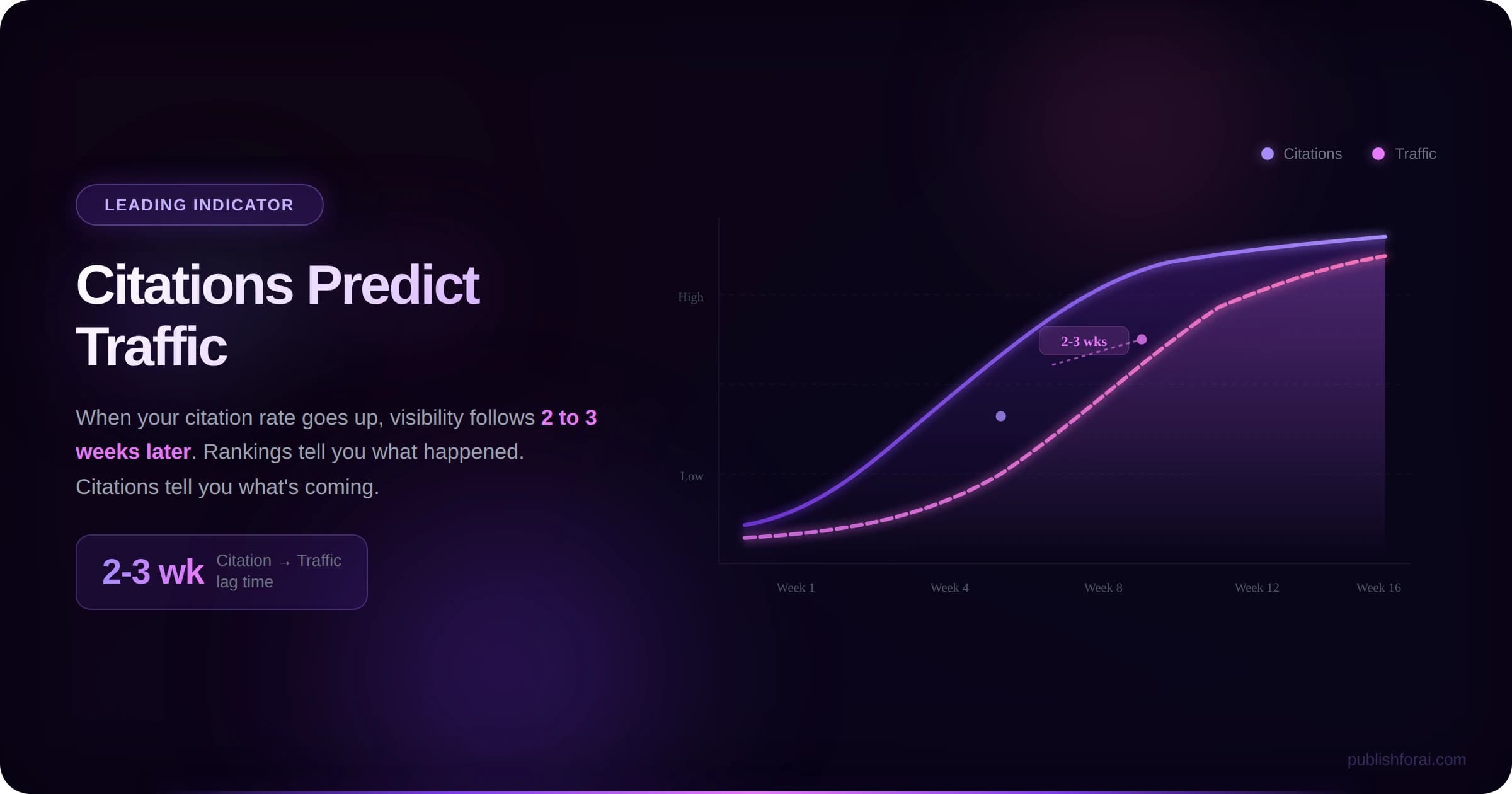
AI citations occur when search engines like Google AI Overviews, ChatGPT, or Perplexity extract and attribute content from your article as part of their generated answer. They matter because citations are a leading indicator: when your citation rate increases, AI search visibility and traffic follow within 2 to 3 weeks. In 2026, tracking citations is more predictive of future traffic than tracking traditional organic rankings.
What One SaaS Company Learned That Most Publishers Still Miss
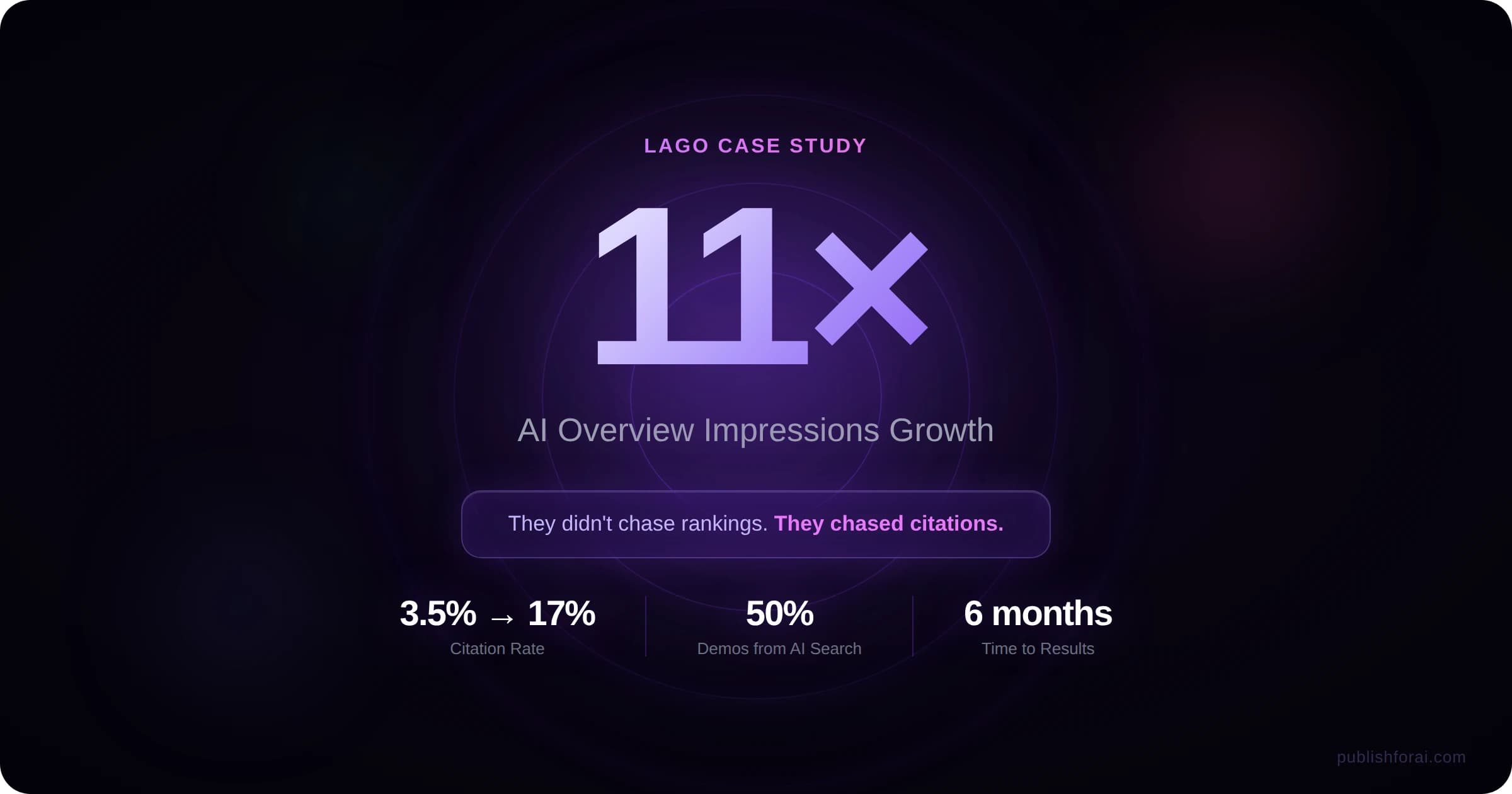
A billing software company called Lago recently shared something that caught my attention. They grew their AI Overview impressions by 11× in six months. Their citation rate jumped from 3.5% to 17%. And half of their booked demos now come through AI search.
Those are SaaS numbers, not publisher numbers. But the underlying mechanic is the same, and it’s the part most people are missing.
They didn’t chase rankings anymore, but citations.
Lago’s Head of Content built a weekly system around one core idea: if you get cited first, impressions follow. Not the other way around. He tracked citation curves as his primary KPI, grouped prompts into cohorts, and watched AI Overview impressions spike 2 to 3 weeks after citations did.
That’s a leading indicator. And it changes how you should think about every article you publish.
Why Your SEO Dashboard Is Missing the Most Important Metric
Traditional SEO dashboards were not built for AI search. They track rankings, clicks, and impressions from organic results. But they don’t measure whether your content is being cited in AI Overviews, pulled by ChatGPT, or referenced by Perplexity.
That blind spot is the problem. Lago figured it out early and built their own citation tracking. Most publishers don’t have the engineering resources for that. But the insight still applies: if you’re not measuring citations, you’re missing the metric that actually predicts where your traffic is heading.
Rankings tell you what happened. Citations tell you what’s ABOUT to happen.
How Citations Became the Leading Indicator in Search
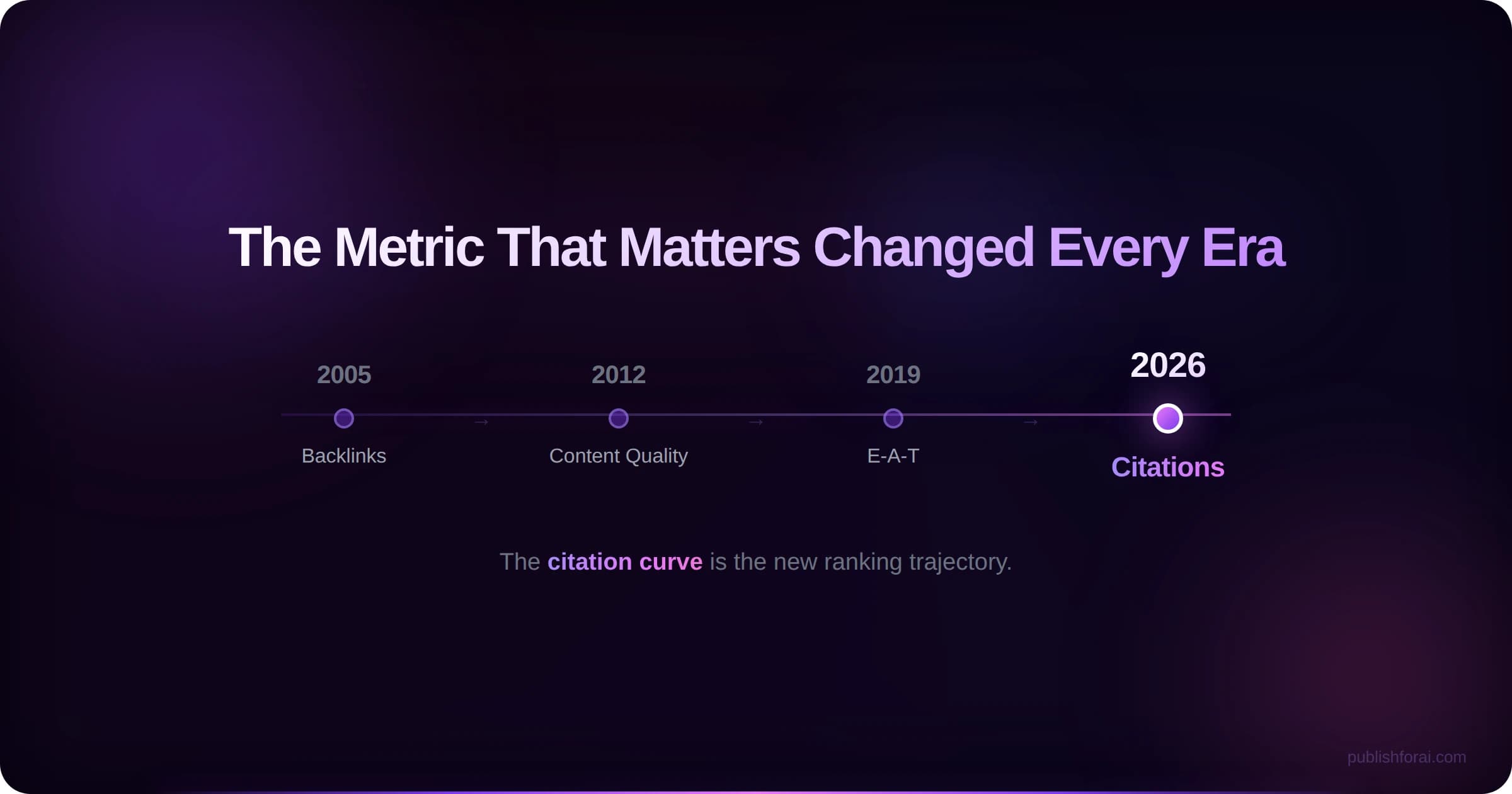
The metric that matters in search has shifted roughly every five years. In 2005, it was backlinks. In 2012, it was content quality signals after Panda. In 2019, it was E-A-T. In 2026, it’s citations.
A citation means an AI engine has evaluated your content, deemed it trustworthy enough to extract from, and presented it as part of its generated answer. That is the machine telling you: you are a source.
What Lago demonstrated, and what I’ve seen across dozens of publisher sites over 21 years in search: citations are predictive. When your citation rate goes up, visibility follows. When it doesn’t, no amount of ranking improvement will compensate for the zero-click reality.
The citation curve is the new ranking trajectory. It tells you where your traffic is heading before your analytics dashboard does.
Three AI Engines, Three Different Citation Systems
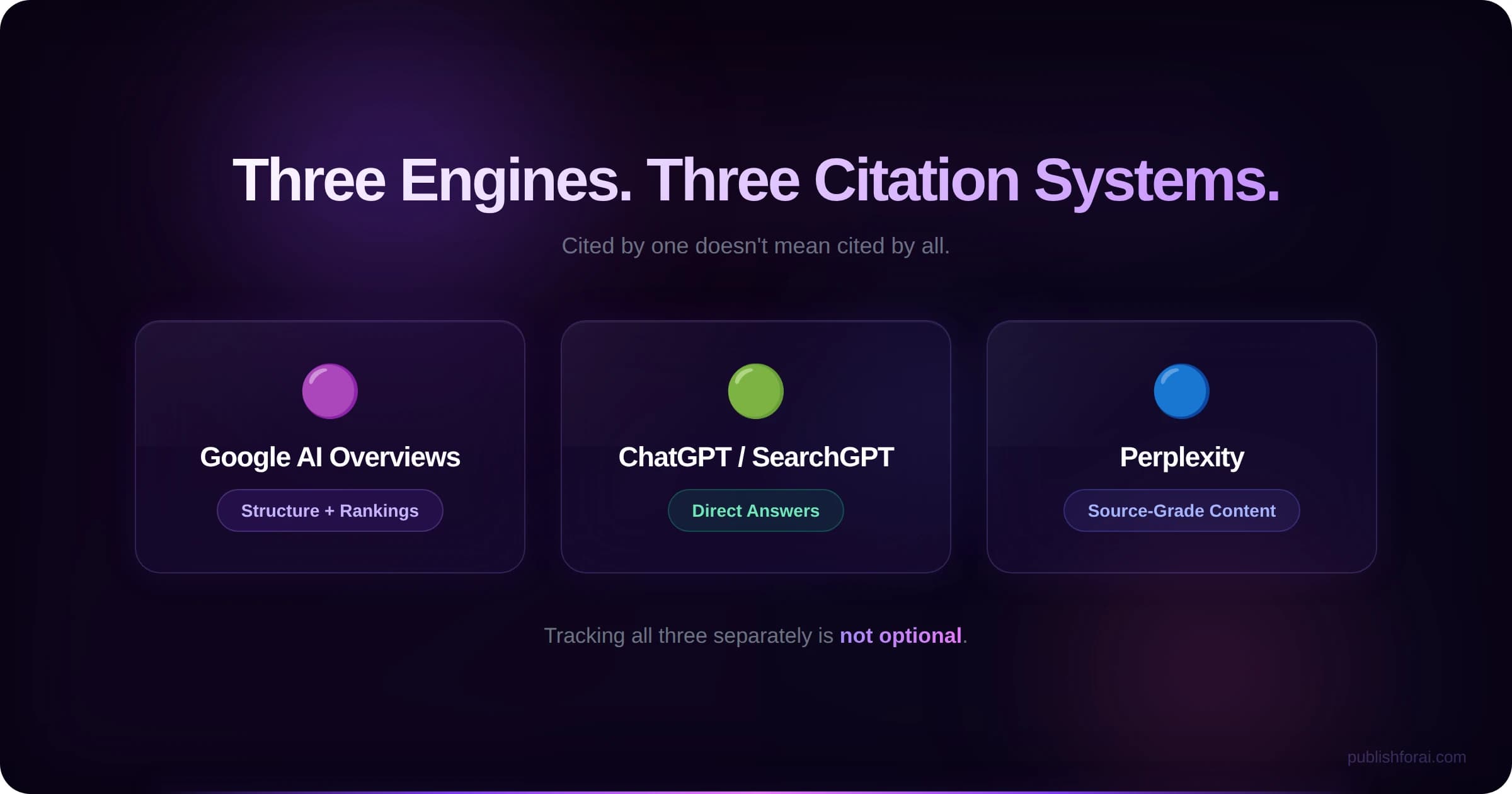
Citation tracking is harder than traditional rank tracking because there is no single search engine to monitor anymore. There are at least three that matter, and each one evaluates content differently.
Google AI Overviews
Google AI Overviews pull from pages that already rank organically, but they don’t cite every page that ranks. They favor content with clear, extractable passages: structured answers, specific data points, named authors, and recent publication dates. Being on page one is necessary but not sufficient.
ChatGPT and SearchGPT
ChatGPT uses web search to find sources in real time. It tends to favor pages that answer questions directly, include structured data, and come from domains with topical authority. It is less tied to traditional rankings and more influenced by how well your content matches the conversational query.
Perplexity
Perplexity is the most citation-heavy of the three. It natively attributes sources and tends to pull from content that is well-structured, recently published, and rich in specific facts. If your article reads like a source document rather than a blog post, Perplexity notices.
The implication: you can be cited by one engine and completely invisible to the other two. Tracking all three separately is not optional. It is the only way to know where you actually stand.
What Lago Did That Most Publishers Don’t
Lago’s playbook had five components. Not all of them translate directly to publishers, but the principles behind each one do.
1. They Identified Prompt Gaps
They searched for the prompts where competitors appeared but Lago didn’t. For publishers, this means asking: when someone types your topic into ChatGPT, whose article comes up? If it is not yours, that is the gap you need to close.
2. They Created Citable Content
Not just good content. Content specifically designed to be stable, structured, and extractable. Owned research, product documentation, and third-party discussions. For publishers, this translates to: data you collected yourself, answers that stand alone without surrounding context, and sections formatted so a machine can pull them cleanly.
3. They Built a Social-to-Citation Loop
Lago contributed to over 300 social threads and tracked when those threads became AI sources. This is relevant for publishers too: if your Reddit comment or forum answer links back to your article, and that thread gets indexed by AI, you have created a citation pathway.
4. They Tracked Citation Curves Weekly
Not monthly. Not quarterly. Weekly. Because citations move fast. What gets cited this week might not next week if a competitor publishes something more specific or more recent.
5. They Treated GEO as Its Own Discipline
Separate KPIs, separate playbooks, separate feedback loops. Not an add-on to SEO. Not a checkbox. A practice with its own measurement system.
How To Start Tracking Your AI Citations Today
You do not need an engineering team to start tracking citations. But you do need to be intentional about it. Here is a five-step process you can start this week.
Step 1: Pick Your Top 5 Keywords
Choose the ones that matter most to your business. Not the ones with the highest volume, but the ones where being cited would actually move the needle for your traffic and authority.
Step 2: Check Each Keyword Across All Three Engines
Search your keyword in Google and look for AI Overviews. Ask ChatGPT the same question. Run the same query in Perplexity. Note whether you appear, in what position, and who else is cited alongside you.
Step 3: Document Your Baseline
You need a starting point. For each keyword, record: cited or not, on which engine, in what position, and who your competitors are in that citation space. Without a baseline, you cannot measure progress.
Step 4: Optimize the Structure, Not Just the Content
In most cases, the content itself is fine. What is missing is the structure that makes it extractable. That means snippet-ready answers near the top of your article, clear section headings that map to search queries, FAQ blocks with schema markup, and specific data points instead of vague claims.
This is where tools like Publish for AI can help. One optimization run analyzes your article against live SERP data, checks competitor structures, and shows you exactly where the structural gaps are across all three engines.
Step 5: Re-check in 2 to 3 Weeks
Lago’s data showed citations leading impressions by 2 to 3 weeks. Give your optimized content time to be re-indexed and re-evaluated, then measure again. If your citation status improved, the traffic impact is on its way.
What This Means for the Future of Publishing
What Lago proved is not just a clever growth hack. It is evidence that the way search distributes value is fundamentally changing.
In the old model, you ranked and got clicks. In the new model, you get cited and get authority. The clicks may or may not follow, but the authority compounds. Every citation reinforces your position as a source. Every time an AI engine pulls from your content, it becomes more likely to do so again.
For publishers, this is both a threat and an opportunity. The threat: if you are not being cited, you are not just losing traffic. You are losing your position as a trusted source entirely. The opportunity: most publishers are not tracking this at all. The ones who start now will have a meaningful head start.
Citations are the new rankings. And the publishers who track them first will own the next era of search.
Key Takeaways
- ✓Citations are the leading indicator for AI search visibility. When citations increase, impressions and traffic follow within 2 to 3 weeks.
- ✓Traditional SEO dashboards do not track citations. You need to monitor Google AI Overviews, ChatGPT, and Perplexity separately.
- ✓Lago grew AI Overview impressions 11× by making citation tracking their primary KPI, not rankings.
- ✓Content structure determines citability. The same information in a different format can be the difference between being cited and being invisible.
- ✓The publishers who build citation tracking into their workflow now will have a significant advantage as AI search grows.
- ✓Want to see whether your articles are being cited? Publish for AI includes built-in citation tracking across all three engines, plus structural optimization to improve your citability. Optimize your first article for free.
Frequently Asked Questions
An AI citation occurs when a search engine like Google AI Overviews, ChatGPT, or Perplexity extracts information from your content and presents it as part of its generated answer, with attribution to your page. It is the AI equivalent of being quoted as a source.
SEO (Search Engine Optimization) focuses on ranking in traditional organic results. GEO (Generative Engine Optimization) focuses on getting your content cited by AI-powered search engines. GEO requires different KPIs, primarily citation rates and prompt coverage, rather than traditional ranking positions.
Search your target keyword in Google (look for the AI Overview box), ask ChatGPT the same question using web search, and run the query in Perplexity. Check whether your domain appears as a cited source. Tools like Publish for AI automate this across all three engines.
Based on Lago’s data, citations typically lead traffic improvements by 2 to 3 weeks. After your content gets cited, AI engines gradually increase its visibility in generated answers, which drives impressions and eventually clicks.
Yes. Google AI Overviews, ChatGPT, and Perplexity each use different systems for selecting sources. Your content might be cited by Perplexity but invisible to ChatGPT, or appear in AI Overviews but not in Perplexity. That is why tracking all three separately is essential.
AI engines favor content with clear, self-contained passages in the 120 to 180 word range, specific data points and named sources, question-based headings, FAQ sections with schema markup, visible author credentials, and recent publication or update dates.
In most cases, no. The content itself is usually fine. What needs to change is the structure: how information is organized, whether answers stand alone, whether sections are extractable, and whether technical SEO elements like FAQ schema are in place.
A citation curve tracks how often your content is cited by AI engines over time. It functions as a leading indicator: when the curve trends upward, traffic growth typically follows. Tracking citation curves weekly allows you to predict visibility changes before they show up in traditional analytics.